
Owner’s engineering support
Electrical Reliability Programs
Know which equipment needs attention, when testing requires an outage, and what your team needs to resolve before the next maintenance cycle.

The five-phase roadmap
Phase 1
Assess & Prepare
Walk down priority equipment, reconcile records, and identify outage and thermal-imaging needs.
Baseline asset register and outage needs
Phase 2
Test & Verify
Coordinate scoped testing of distribution equipment and review the results against the agreed test criteria.
Test results and prioritized exceptions
Phase 3
Document & Coordinate
Review lightning protection where in scope, coordinate drawing updates, and organize the equipment records.
Updated records and assigned follow-up
Phase 4
Train & Report
Brief the facility team on findings, recommended actions, and the procedures they will use to run the program.
Findings report and training as scoped
Phase 5
Sustain & Plan
Maintain the recurring schedule, review open findings, and identify equipment priorities for capital planning.
Maintenance calendar and capital priorities
Sample data
Maintenance dashboard
A four-week example showing what the facility team has completed, what is due next, and which findings still need action.
- Tasks complete
- 5 of 8
- Upcoming tasks
- 3
- Open findings
- 2
Showing 8 of 8 sample tasks
| Task and asset | Planned | Status and follow-up |
|---|---|---|
| Visual inspectionSWGR-01 | Week 1 | Complete |
| Infrared surveyMCC-02 | Week 1 | Complete. High · Review a temperature exception |
| Visual inspectionPNL-07 | Week 2 | Complete |
| Transfer testATS-01 | Week 2 | Complete. Routine · Complete the test record |
| Infrared surveyPNL-09 | Week 2 | Complete |
| Protective device testingSWGR-02 | Week 3 | Upcoming |
| Electrical testingMCC-04 | Week 3 | Upcoming |
| Transfer testATS-02 | Week 4 | Upcoming |
Measured field data
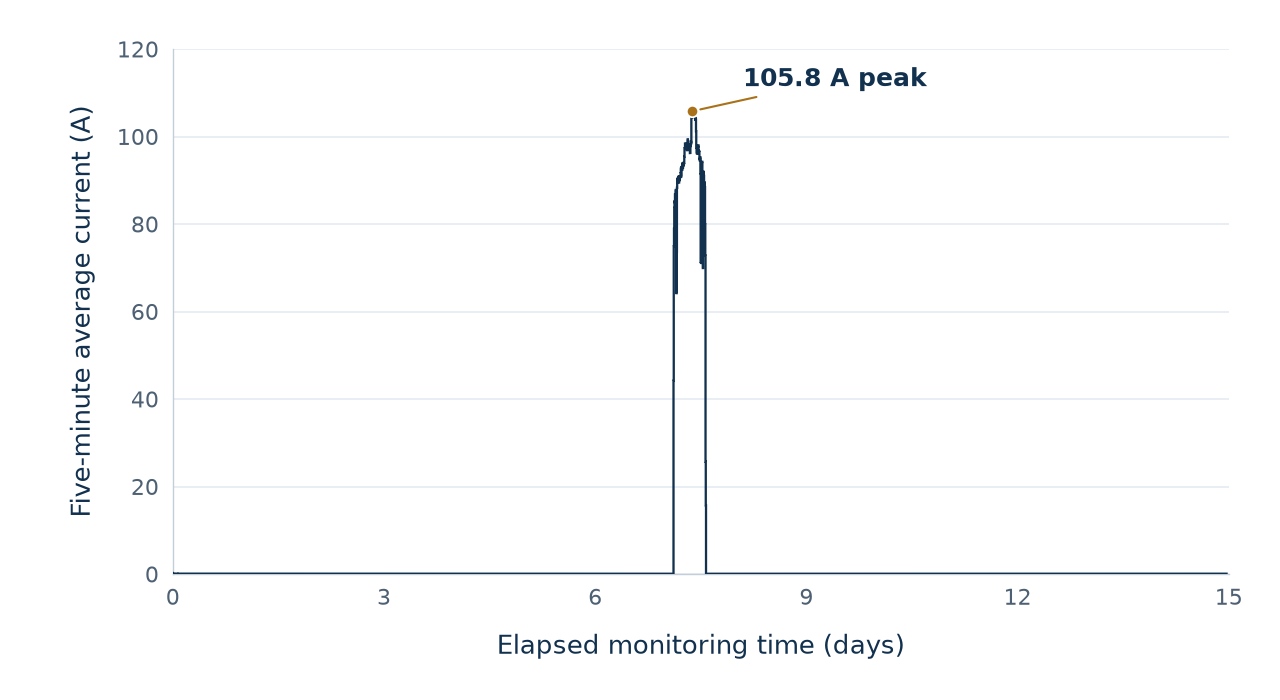
Recorded current trend
Recorded Phase A RMS current from a separate AES load evaluation, shown in amperes over elapsed time.
An example recurring schedule
| Maintenance activity | Example interval |
|---|---|
| Infrared thermography | Annually |
| MCC and switchgear testing | Every 3 years |
| Lightning protection inspection and testing | Every 5 years |
| Arc-flash study review, where applicable | Every 3 years |
AES determines the schedule for each facility using equipment condition, manufacturer instructions, the applicable standards and site requirements. Equipment or operating changes may call for earlier review.
How the agreement works
Under a Programmatic Services Agreement, the owner and AES agree on the engineering and oversight scope, a phased rollout, and an annual budget ceiling for the defined work. AES serves as the owner’s engineering point of contact for planning, testing coordination, and follow-up.
How NFPA 70B informs the plan
NFPA 70B is the Standard for Electrical Equipment Maintenance. AES uses the edition applicable to your facility to help develop and document the maintenance program. Facility requirements may also come from the jurisdiction, owner specifications, contracts, or insurer. Confirm those requirements when setting the scope.